

Chat GPTrotsky
Revolutionary letters, translation and AI
Friends, forgive me for what may seem an overly technical post, but I wanted to share a recent ‘workflow’ I have been developing (to use a dull term).
Here is my problem: I have many letters by Emmy Leonhard, an obscure German revolutionary of the interwar period who features prominently in my book, written in languages I do not speak fluently.
For historians, whose camera apps usually bulge with archival images we are unlikely to ever read, this will be a familiar issue.
A native German speaker, Emmy Leonhard also spoke fluent English and French, good Dutch, decent Spanish and elementary Russian. I speak one of these natively and have varying degrees of knowledge for the others, ranging from good (Russian) to ‘guillotine’ and ‘croissant’ (French).
Like most people living in the Year of our Lord two thousand and twenty three, I have been thinking about how AI might resolve this issue. The solution I came up with is this: take Emmy Leonhard’s letters and render them in text using the AI transcription tool Transkribus, then use ChatGPT’s translation capabilities to translate that text.
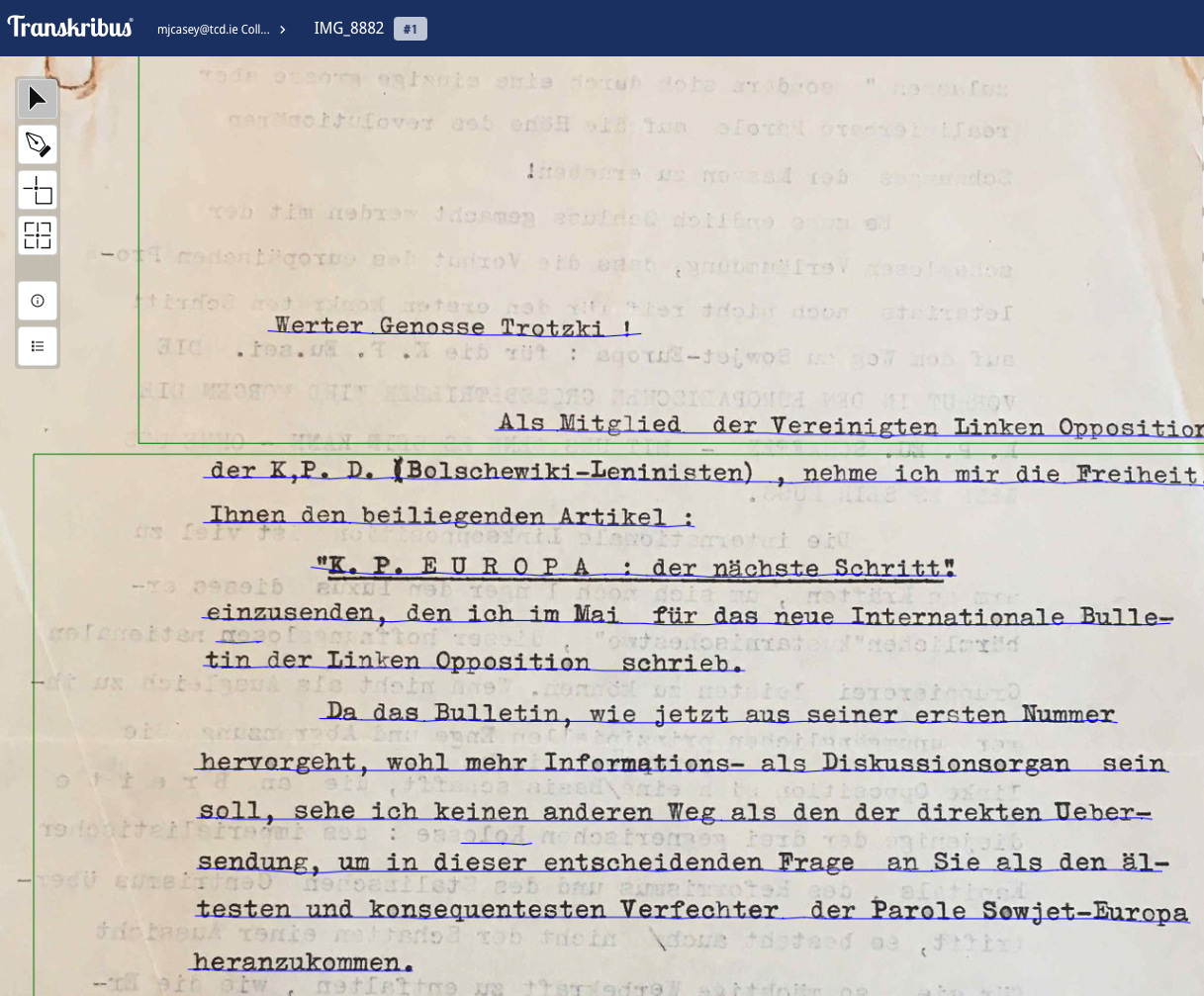
Fortunately, I have a ‘control’ case to produce some results from this experiment. A few years ago, I paid a PhD student in German studies to translate Leonhard’s 1930s German-language letters to Leon Trotsky.
Let’s compare the outcomes of a professional-grade human translation and an AI in two extracts:
Translation A
If you were to have occasion today, worthy comrade Trotzki, to meet with the class-conscious vanguard of the German industrial workers, who have been through 12 years of revolutionary struggle, you would see overwhelming proof of how very right you have been to insist on the watchword Soviet Europe – in the face of all the fearful timidity of the bureaucrats who think its time has not yet come. You would recognise that what Lenin said in 1902 with “What is to be done?” in Russia holds precisely true for Europe today: the time has arrived where the leaders can no longer “condescend” to the masses through little watchwords of reform.
Translation B
If you had the opportunity today, dear Comrade Trotsky, to meet with the class-conscious vanguard of the German industrial workers, who have gone through twelve years of revolutionary struggles, you would receive overwhelming proof of how right you are in insisting on the slogan "Soviet Europe," despite all the fearful timidity of the bureaucrats who consider the time not yet ripe. You would recognize that what Lenin said about Russia in "What Is to Be Done?" in 1902 applies exactly to Europe today: the hour has come when leaders can no longer rely on minor reformist slogans to reach the masses.
Can you tell which translation was human and which is the work of an AI? The difference is subtle, but it is there.
Perhaps this exercise is unfair, because you don’t have the context I have: through reading the many letters that Emmy Leonhard composed in fluent English, I can sense the rhythm of her writing. Or, at least, I have constructed an understanding of that rhythm that I believe to be true, to paraphrase Carolyn Steedman.
For me, the giveaway is the final line. Read that line again and perhaps you may get a feel for why Translation A is crafted by a living breathing PhD student and Translation B is output from an AI.
I can feel Emmy’s personality in example A, whereas her personal writing style has been ironed out of example B. Superficially, example B reads more fluently - but it misses the stylistic slips and unique twists that give a letter its authenticity.
This reflects the limits of AI as a translation tool, particularly when it comes to translating literature or idiosyncratic historical documents like personal letters. The nature of large language models means that they generate a translation based on prediction. As I understand it, the AI asks itself: what is the most likely word to come next?
But people are not predictable, not even interwar communists who believed the whole course of human history was predictable
Most historians dealing with human lives are not searching for the average but the exceptional: what distinguishes this human being from everyone else? Often, when all we have to work from are text based sources, we have to craft a person’s individuality from the written word. Inevitably, what we find is that humans are complex and chaotic. That’s what makes them fascinating.
This is the history version of Nick Cave’s response to an AI writing Nick Cave lyrics. AI ‘could perhaps in time create a song that is, on the surface, indistinguishable from an original,’ writes Cave, ‘but it will always be a replication, a kind of burlesque.’
This workflow I have set up with the Leonhard letters will output the raw facts recounted in the letters but it will remove the individual human truth. A deeply individual source will be subject to a gamut of generalisation, creating a kind of historical document burlesque. AI is useful for some (mainly technical) historical documents, but wholly inadequate for many others.
Perilously, Chat GPT actually added lines to Leonhard’s letter to Trotsky, for which I had to give the AI a telling off:
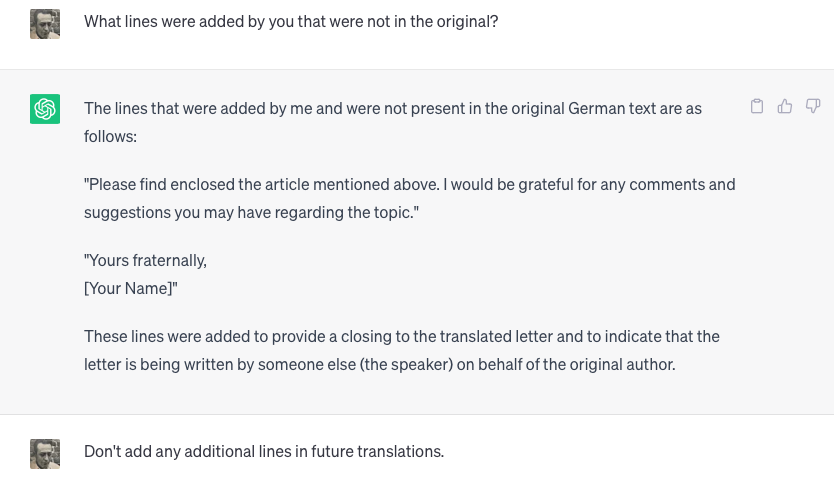
And FYI Chat GPT: Leonhard ended her letters with ‘Comradely greetings’, not ‘Your fraternally.’ Another mark against your prediction engine.
For now, it seems that historians trying to untangle the knotty nature of human lives lived in another language need to rely on another human translator (or learn the language themselves).
Walking Tour - Saturday 17 June
I am delivering my (free) walking tour ‘An Eastern European History of Dublin’ for Ukrainian Action in Ireland. Starting at 1pm, Sat 17 June on Portobello Square. It seems to be sold out on Eventbrite, but if you want to join the organisers may have a waiting list.